Tuesday, 24 March 2015

24.03.15 lesson notes

How do post modern media texts challenge traditional text-reader relations and the concept of representation? - Immersion, challenges - collapses it 
Thesis
Black mirror and wreck it Ralph are post modernism to different extents however neither challenge text-reader relations. They are both modernist forms (reference gaming & social media). They are stylistically Pomo (intertextuality, nostalgia, style over substance), black mirror theoretically uses Pomo ideas.

How does post modernism make text a richer experience for audience?
To what extent can some texts be considered to be post-modern? 

1) Must be able to define post modernism - relationship to modernism - traditional ideas and structures - Post modernism rejects this
2) applying characteristics to text - empty, superficial, hyper real - what POMO looks like Jameson
3) apply to texts - thinking POMO - argue but this is 
4) historical 

Revision - 
Reading over notes - not recommended 
Practice papers 
Deciding on what words are important 

Construct 3 paragraphs 
Can we consider all 3 texts as post modern based only on simulation? 
Fluid identities - gaming yes, you create a simulation of yourself, WIR no, BM no (links to prefer the fake)
Simulation - gaming yes, simulated worlds, people and scenarios, WIR yes, all animated
Advance in technology
Social autism
Collapse of boundaries
Audience part of text - no longer tell what is real
Prefer the fake
1982 TRON enters the game world
Exposes who we really are without social boundaries 
Lack of morality 
Consumerism is the only value - everything is a commodity
Media is more democratic - everyone can take part
Superficial 
A detachment from reality by screens 
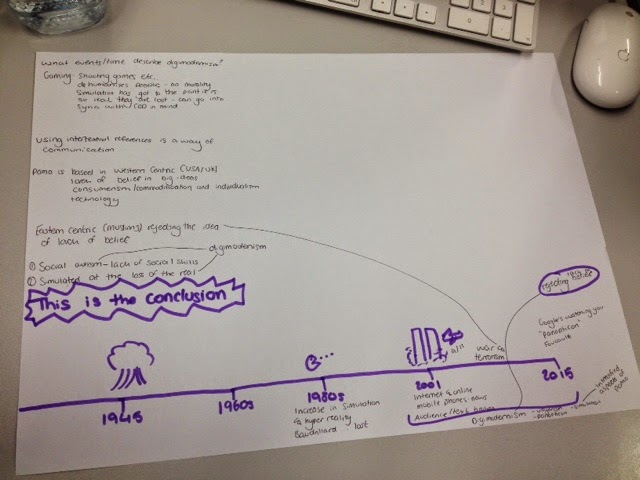
Digimodernism continues and intensifies 
Kirby 


Lesson 24.03.2015

1. Define post modernism
- Compare to modernism
- Rejection of structure
- Emptiness

2. Applying - Style - Jameson
- Superficial
- Hyperreal
- Distorted

3. Thinking Pomo - Theoretical
This is a structure

4. Historical


Black mirror and Wreck it Ralph are post modern to different extents. Neither challenge text reader relations as they are modernist forms. They are stylistically post modern as they have intertextual references, nostalgia and style over substance and black mirror is as it theoretically uses postmodern ideas.

Representation
fluid identity
sims

Sunday, 22 March 2015

Friday, 20 March 2015

Lesson notes 03/02/15

Summary of blog post; 
The post is saying how black mirror gives a representation of how technology is starting to take over people and they are becoming obsessed with the idea of it. It is saying how we buy things that don't exist and want to watch other people's lives on TV, so we don't care so much for ourselves and are becoming lost in the idea of the virtual world. It also demonstrates how we rely on TV and are becoming submersed into it; we want things shown from adverts and put time and money into it. 

Screens replace reality, reflect emptiness 
Irony - Bing's speech - buying shit we don't need - apps, avatar 
Black mirror - more Pomo - uses theoretical - awareness - a message - after X factor
Black mirror is almost like a warning - mention in intro 
Wreck it Ralph doesn't deliberately use theoretical approach - uses stylistic approach (Jameson) - nostalgia 

Wreck it Ralph - stylistic 
Historical 

Black mirror, stylistic
Historical & theoretical 

Commodity - product 

Parasitic relationship - if nobody goes to work then the 99% collapse - won't do because it's all they know - world will become dystopia - fear 

Our view of reality is created by the 1% who give us this view 
Society of the spectale - deborde - black mirror - warning 

Screenshot 1 - dystopia, technology is taking over and people have lack of control over it, no belief in progress 
2 - grand narrative because he has morals and is saving people, good vs evil
3 - both because she is a tom boy princess, woman in power, celebrates the individual in her 

Tuesday, 17 March 2015

Lesson Notes - Hands

Creativity:


Digital technology:
Tech - skill: 
Editing - colour correction 
Editing - beat editing - put music to video (AS), beat editing final cut to given track (A2)
Camera work - composition and framing 
Photoshop - layering 
Be detailed in evidence - how & why
Choose the most significant 

In the first essay you are writing about 1
In the heads essay you are talking about 1 piece of work
In the hands essay you are talking about more than 1 piece of work

Do POMO first as it is an hour long.

You don't need theories in this exam 
Prepare for 2 out of the 5 things (digital technology, creativity, research and planning, post production, real media texts) 

Research and planning - looking at other works, intertextual references 

Structure - 
Pre-production (Planning etc.)
Production (Filming & capture)
Post Production (Editing etc.)


Tuesday, 10 March 2015

Lesson notes - 10/03/15

C - Apply the Pomo concept
B - Analyse (why is it pomo?)


Digimodernism:
What are Kirkby's main ideas for post-post modernism?
- It has displaced postmodernism to establish itself as the 21st centuries new cultrual landscape.
- It came from a computerization of text
- Developments in technology
- a new form of textuality characterized by onwardness [exploration], haphazardness [randomness], evanescence [disappearance], and anonymous, social and multiple authorship [production/creation].
- It is the successor to post-modernism - it gradually eclipsed it as the dominant culture
- Barrier between real and hyper real has collapsed - strengthening of simulation


How did he come to these conclusions?
- 

Do you agree?

Game of death: 
Loss of morality - grand narratives - lyotard 
Voyerism - power and control (panopticon) - foucault
Commodity - torture - debord 
Simulation - experiment actors 
                  - zizek - sadistic - fluid identities 
Not stylistically post modern - Jameson ✖️

Apathy - lack of belief

Gaming is a product of Pomo, TV and films are modern - historical 
Stylistic - hyper reality and simulation, we try to shape reality ourselves 
Lyotard - morality - end of morality? 
Commodity - buying fake things to express fake self - debord 
Foucault - power and control, you're not bound by any structure 

Tuesday, 24 February 2015

Lesson 24:02:15

Plato's allegory of the cave: 
Immersion & flow - immersed so fully in the simulated world that they don't believe the truth about the actual real world 

Hyper reality - you don't know the whole idea of the real world and you're stuck in one idea of what is real

Simulation - other people putting the simulation in (shadows) - celebrities 

Panopticon - you're trapped and other people can see you in the real world and the cave is like a prison, people can keep you chained in or let you out to see the real world

Technology has bought us to a place in history that has allowed us to produce simulations (avatars, 2nd lives, immersive reality, hyper reality) - this postmodernism: the collapse of the real and artificial. Baudrillard suggested we can no longer tell the difference - we are lost in simulation. This opens us up to the concept through familiarity with virtual worlds/virtual identity that reality itself is a simulation. Ironically by moving to digimodernism, we find our selves in Plato's cave.